> For the complete documentation index, see [llms.txt](https://ei-docs.keywordrush.com/llms.txt). Markdown versions of documentation pages are available by appending `.md` to page URLs; this page is available as [Markdown](https://ei-docs.keywordrush.com/synchronizing-products/general-information.md).
# General information
Keep your WooCommerce catalog up to date with automated price and stock synchronization. Learn how External Importer sync modes and controls work.
### Synchronizing products
External Importer can automatically update **prices** and **stock status** for imported products in your WooCommerce store.
You can configure synchronization at:\
**External Importer → Settings → Synchronization**
#### How synchronization works
Many online stores change prices and availability frequently.\
External Importer doesn’t provide *real-time* prices in your WooCommerce catalog, but it will periodically refresh product data based on your sync settings.
A few important points:
* **No real-time pricing**\
External Importer updates products on a schedule, not instantly on every price change at the source.
* **Avoid too-frequent updates**\
If you sync very often – especially for many products from the same store – you increase the risk of being throttled or blocked by that source.\
We recommend using a **moderate update interval**, not the shortest possible one.
* **Show last update date on the frontend (optional)**\
You can display when a product was last updated on the product page.\
Go to: **External Importer → Settings → Frontend → Update period** and enable the option.
#### Synchronization modes
External Importer offers two ways to update products:
**1. Frontend synchronization**
When **Frontend synchronization** is enabled, a product can be updated **when a visitor opens its product page**.
**Pros:**
* Only products that actually receive traffic will be updated.
* Reduces unnecessary requests for products that nobody views.
**Cons:**
* Occasionally, visitors may notice a **slight delay** when loading the product page, while new data is being requested from the source.
**2. Cron synchronization (recommended for background updates)**
With **Cron synchronization**, External Importer updates products in the background, on a schedule, without affecting page load time for your visitors.
* **No additional cron setup is required**, although WordPress needs regular traffic to run scheduled tasks. On a site with very few visitors, ask your host to set up a real cron job.
* Products are updated **one at a time**, so a slow or unreachable store cannot hold up everything waiting behind it.
* Updates are **spread evenly across your stores**, and each store's daily request limit is used gradually through the day rather than all at once.
How many products can be updated per day depends on your hosting and on how quickly each source responds – a store behind a scraping service can take fifteen times longer than a fast one. Rather than guess, External Importer measures it: the [Sync status](/synchronizing-products/sync-status.md) page shows how many updates a day your site is actually capable of, and warns you if your update period asks for more than that.
{% hint style="info" %}
Use the [Sync status](/synchronizing-products/sync-status.md) page to check that synchronization is running, see which stores are blocked, and confirm your settings can be met.
{% endhint %}
#### Per-product sync controls
You can control synchronization for each product individually on the product edit screen.
On the **product edit page**, look for the **External Importer Sync** meta box (sidebar):
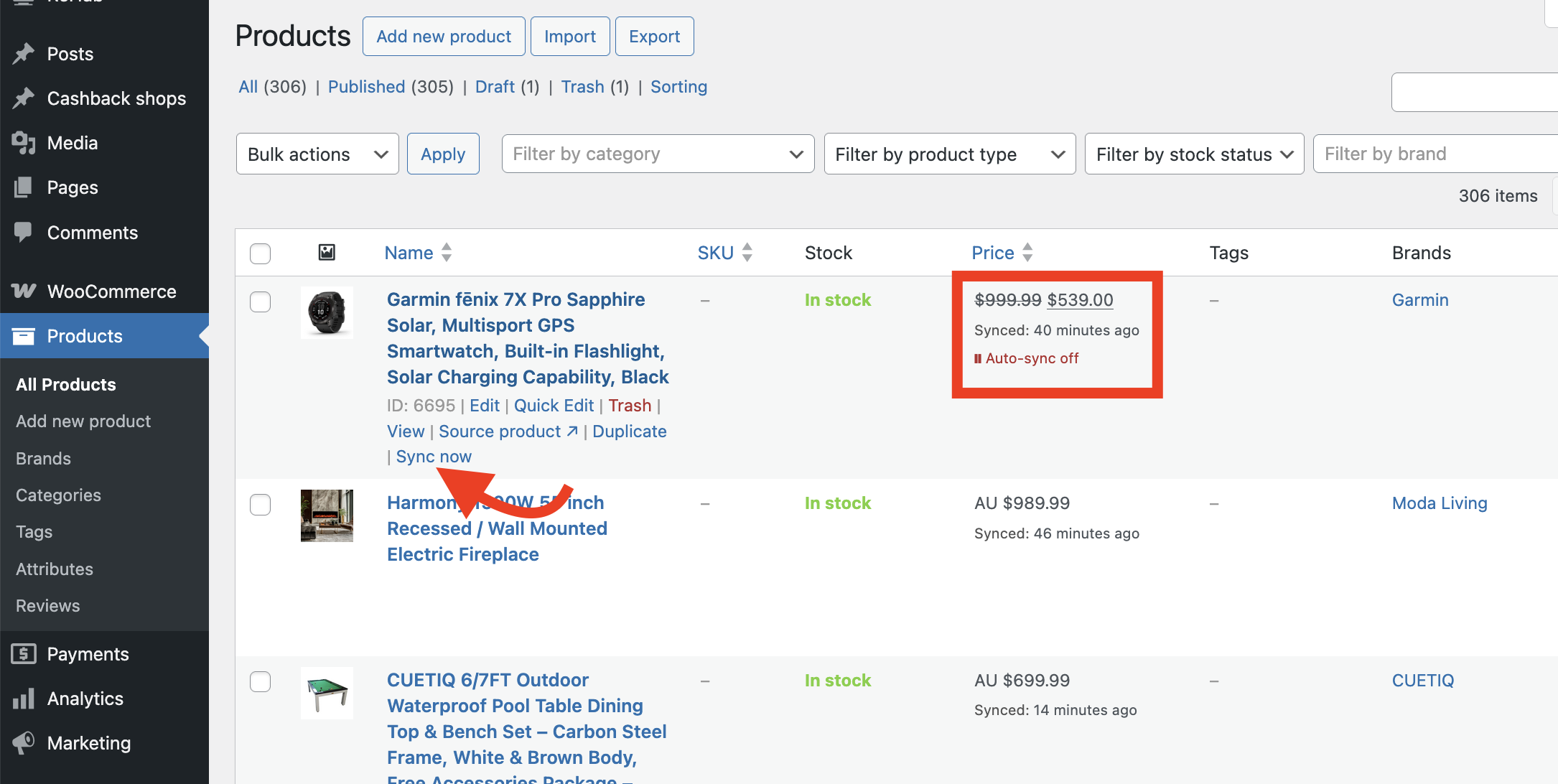
* **Last update & status**\
You’ll see the **last synced time**, current **availability**, and sync **status** (success/error).
* **Manual update (“Sync now”)**\
Click **Sync now** to immediately refresh this product’s data from the source.
* **Disable automatic sync for a product**\
If you don’t want External Importer to update a specific product automatically:
1. Open the product in the editor.
2. In the **External Importer Sync** widget, enable **“Disable auto-sync”**.
3. The product will **no longer be included** in automatic synchronization, but you can still use **Sync now** at any time.
This is useful when you’ve manually edited a product and don’t want your changes to be overwritten.
#### Checking synchronization across your catalog
The per-product widget answers questions about a single product. For the whole catalog – what is being updated now, which stores are blocked or out of requests, and which products are failing – see the [Sync status](/synchronizing-products/sync-status.md) page.